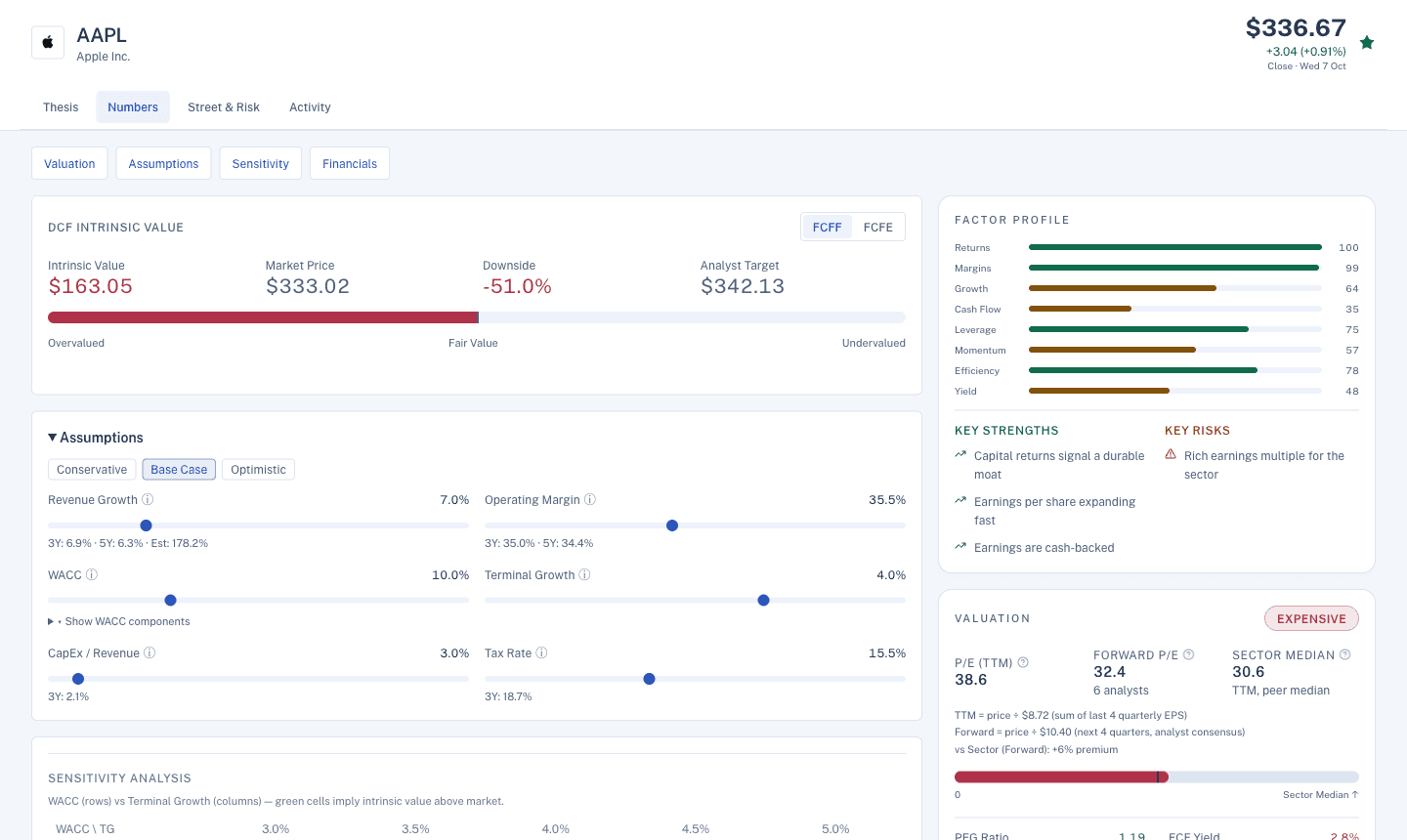
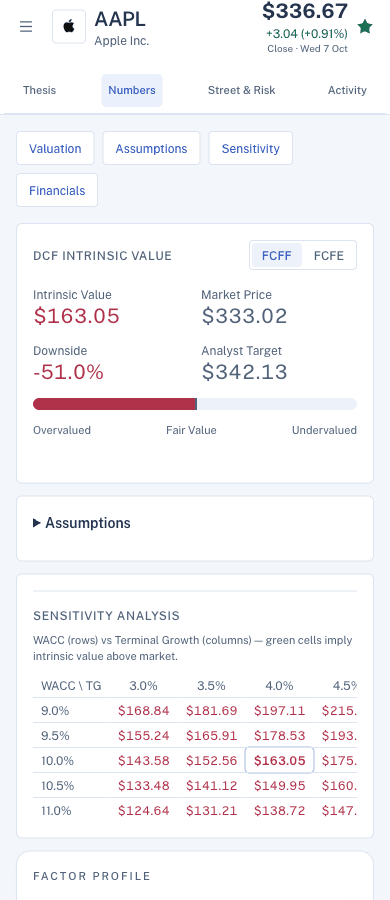
Start with how the company makes money
Read the business description and identify the main sources of revenue. Compare revenue growth with profit margins: a larger business is not necessarily a more profitable one. Look across several reporting periods rather than relying on the latest quarter.
Read the three financial statements together
Income statement
Track revenue, operating profit and earnings. Look for changes in margins and distinguish a growing business from a temporary boost.
Cash flow
Compare reported earnings with operating cash flow and capital spending. Ask how much cash the business needs to sustain its growth.
Balance sheet
Check cash, debt, working capital and changes in shares outstanding. The same profit can carry very different risk depending on financing.
Put valuation in context
Compare multiples with sector peers, while accounting for differences in growth, profitability and risk. A lower P/E can reflect weaker prospects; it is not proof of undervaluation. Read the sector-relative P/E guide.
On the paid plan, analyst estimates add a view of market expectations, and DCF tools let you test your own assumptions. A valuation model is sensitive to those inputs. See why relative and absolute valuation answer different questions.
Write down what could change your view
Identify the conditions your investment case depends on: revenue growth, margins, financing costs or a recovery in demand. Save the company to a watchlist and revisit the evidence when new results arrive.
What is free?
Free accounts include 10 company views each month, annual and quarterly financial data, peer comparisons and a 10-ticker watchlist. Scores are visible for the 200 largest companies. The paid plan adds unlimited company views, the full scored universe, analyst estimates and DCF tools. Compare all plan limits.
Check dates and limitations
Prices, statements and estimates update on different schedules. Missing data, revisions and unusual accounting can affect ratios. Use the displayed dates, read the underlying statements and treat model scores as research inputs.